7.6 Playback Fader Pages
Playback Pages allow you to organize and access different sets of playbacks without changing the show file. Each page acts like a layer, storing specific playback assignments while keeping the console layout clean and flexible. This is useful when working on different parts of a show, such as rehearsals, scenes, or live busking. Switching between pages instantly updates the playbacks, making it easy to manage complex shows with minimal setup.
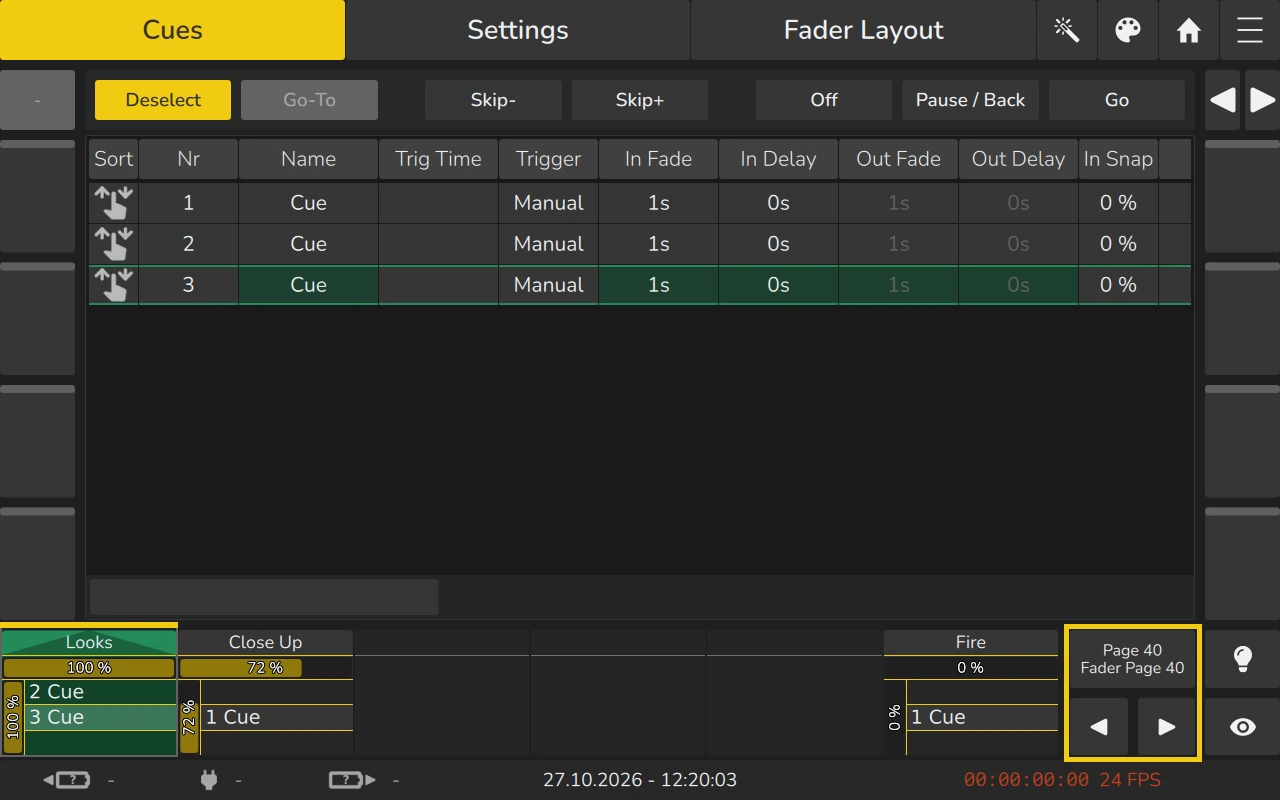
To go one page forward, press the Pg+ button on the front panel or the right arrow below the Playback Page Button.
To go one page backward, press the Pg- button on the front panel or the left arrow below the Playback Page Button.
You can switch between Playback Pages at any time by clicking the Playback Page Button located at the bottom right of the screen. This opens the Fader Page Pool, which is explained in detail below.
The behavior when switching playback pages can be adjusted in Menu → Options → Page Settings (see 5.3.5 Page Change Settings). The available options are:
- Keep active in background – Active playbacks remain running but are hidden when switching pages.
- Keep active in foreground – Active playbacks remain visible and accessible when switching pages.
- Off on Page Change – Active playbacks are switched off when switching pages.
7.6.1 Fader Page Pool
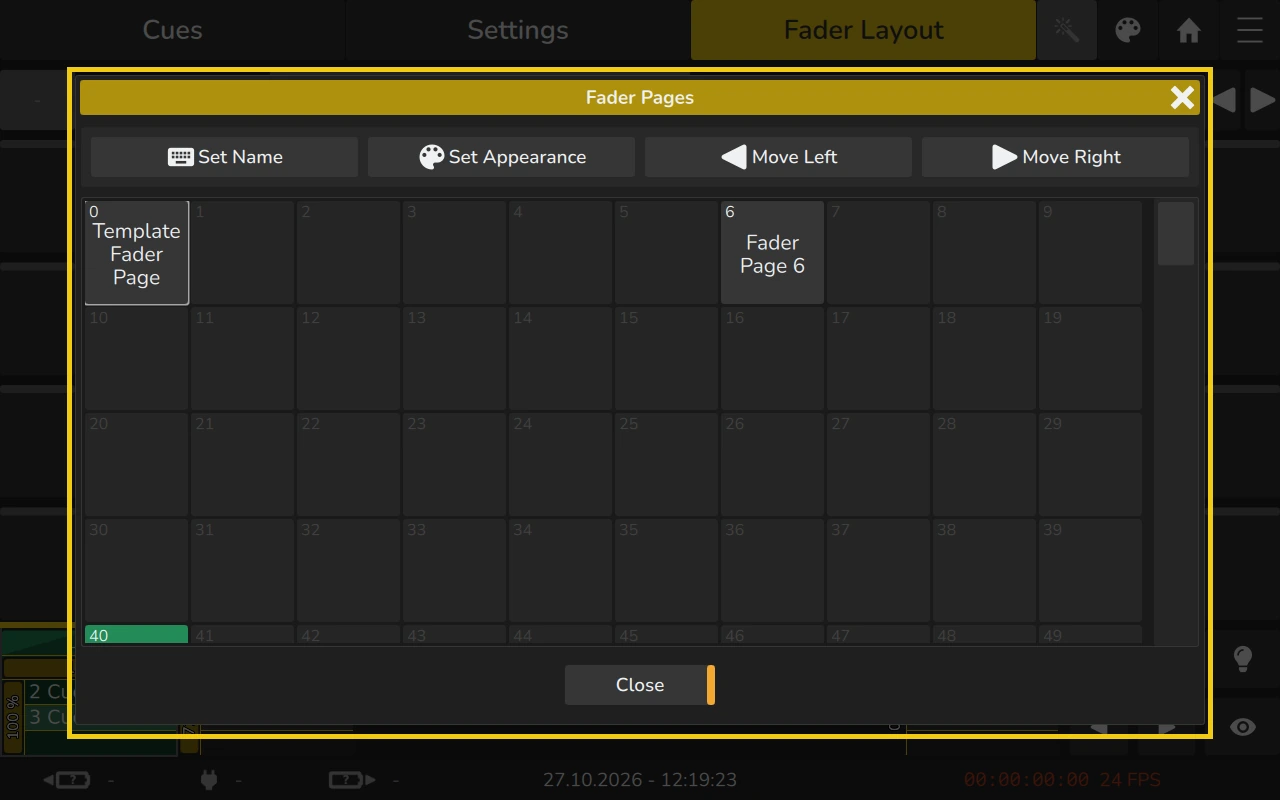
The Fader Page Pool provides an overview of all Fader Pages. It can be opened by clicking on the Page Button in the lower right of the internal screen.
When the Pool is shown, you may select a page by clicking on it.
- Set Name: Click to name the current page.
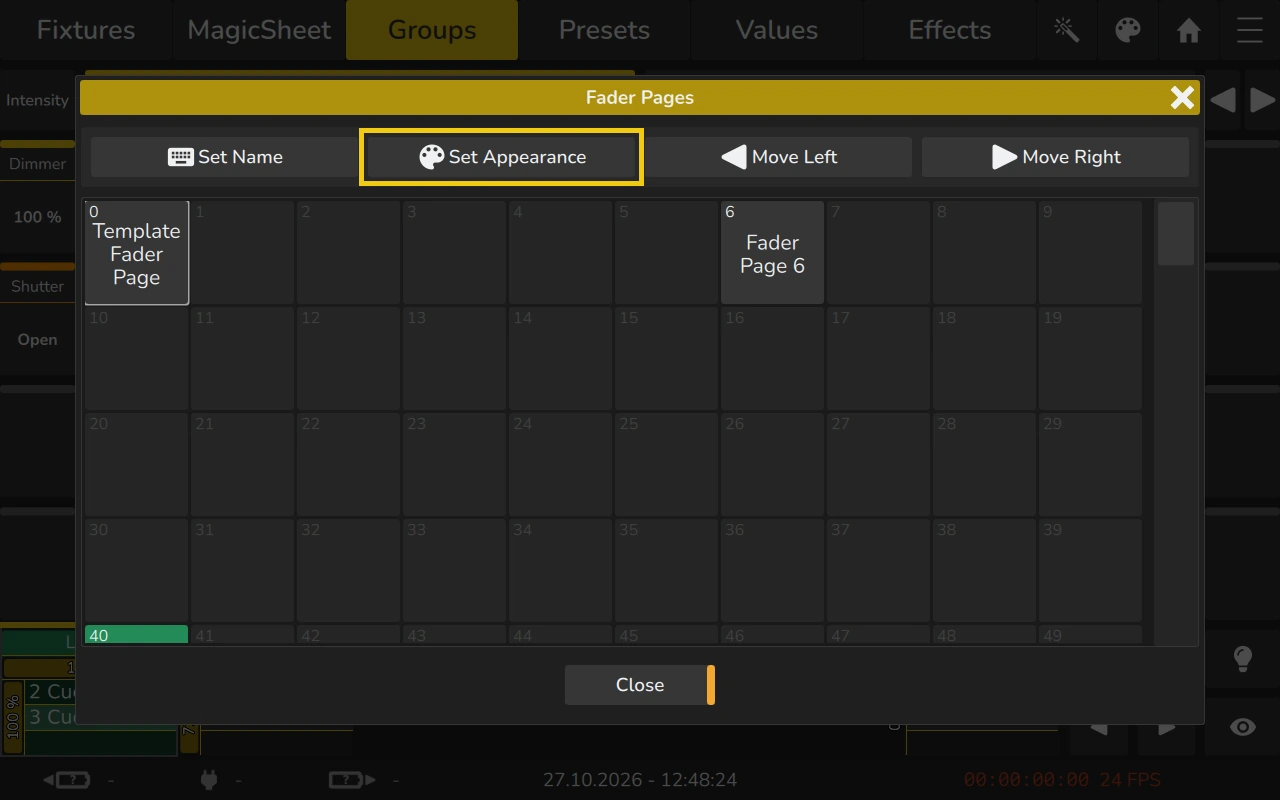
- Set Appearance: Click to set a color for the current page.
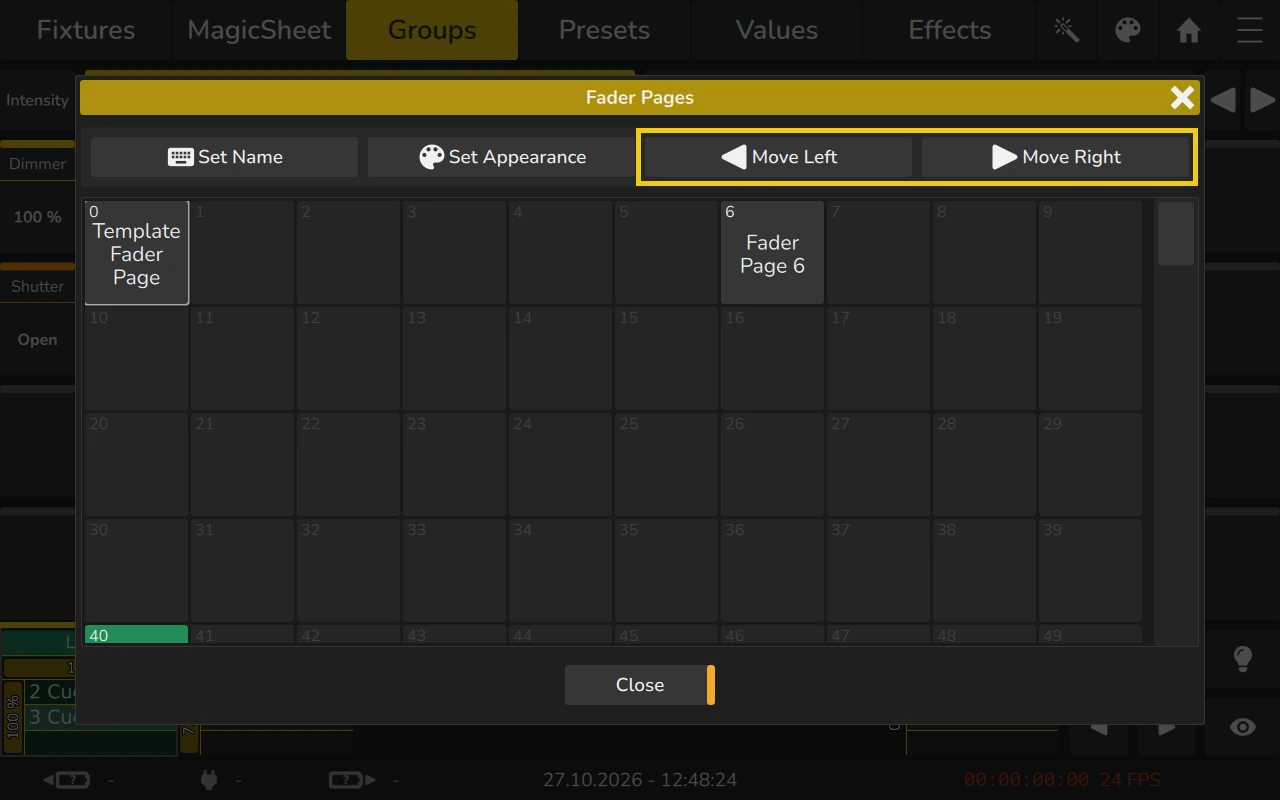
- Move Left: Click to move the current page one position to the left.
- Move Right: Click to move the current page one position to the right.
- Delete: Long-press the page and select Delete from the context menu to remove the page and all its assignments.
The Fader Page Pool also includes a Template Page button. Playbacks assigned to the Template Page are visible on all pages.
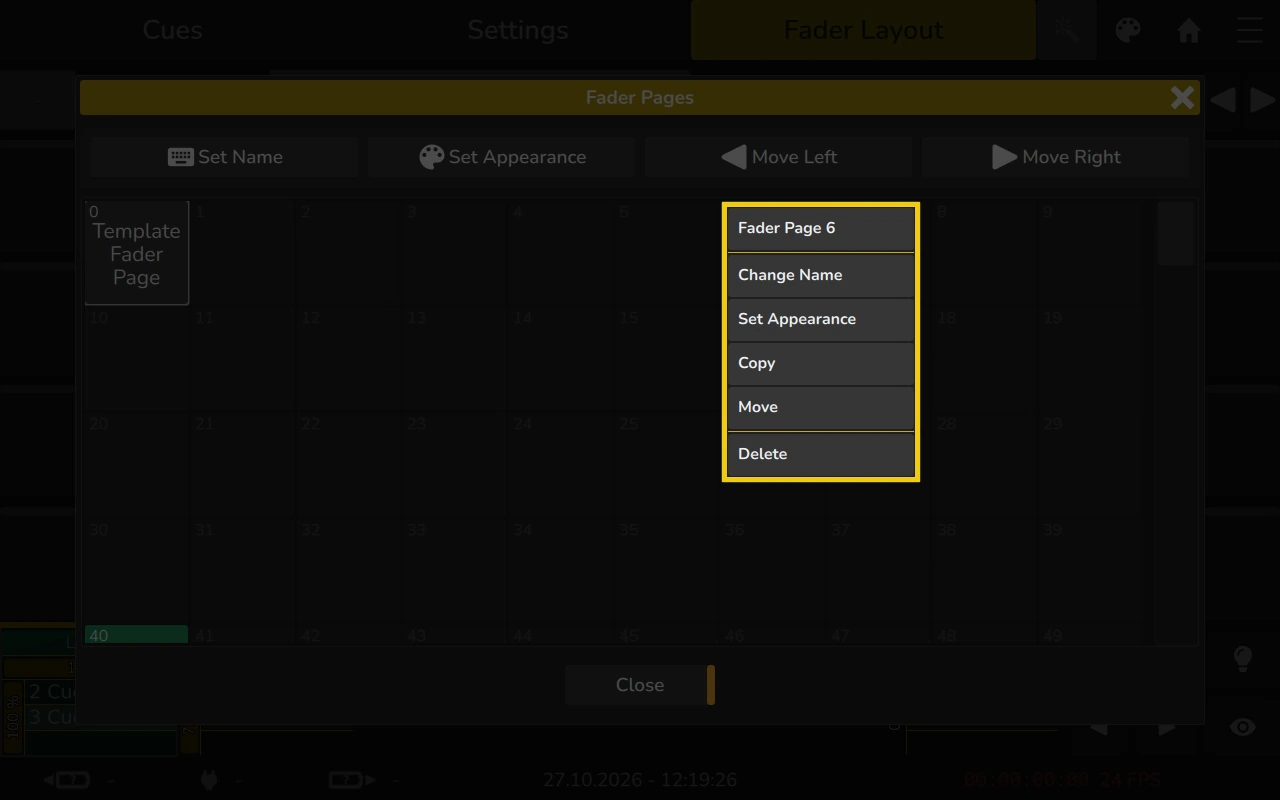
Fader Page Long-Press Menu
Long-pressing on a fader page will open a context menu with Change Name, Set Appearance, Copy, Move and Delete.
7.6.2 Copying Playback Pages NEW
EDGE allows entire Playback Pages to be copied, simplifying the creation of duplicated or alternative Playback layouts.
This functionality is especially useful when building multiple pages with similar structures or creating variations of an existing setup.
To copy a Playback Page:
- Open the Fader Page Pool by clicking the Playback Page Button.
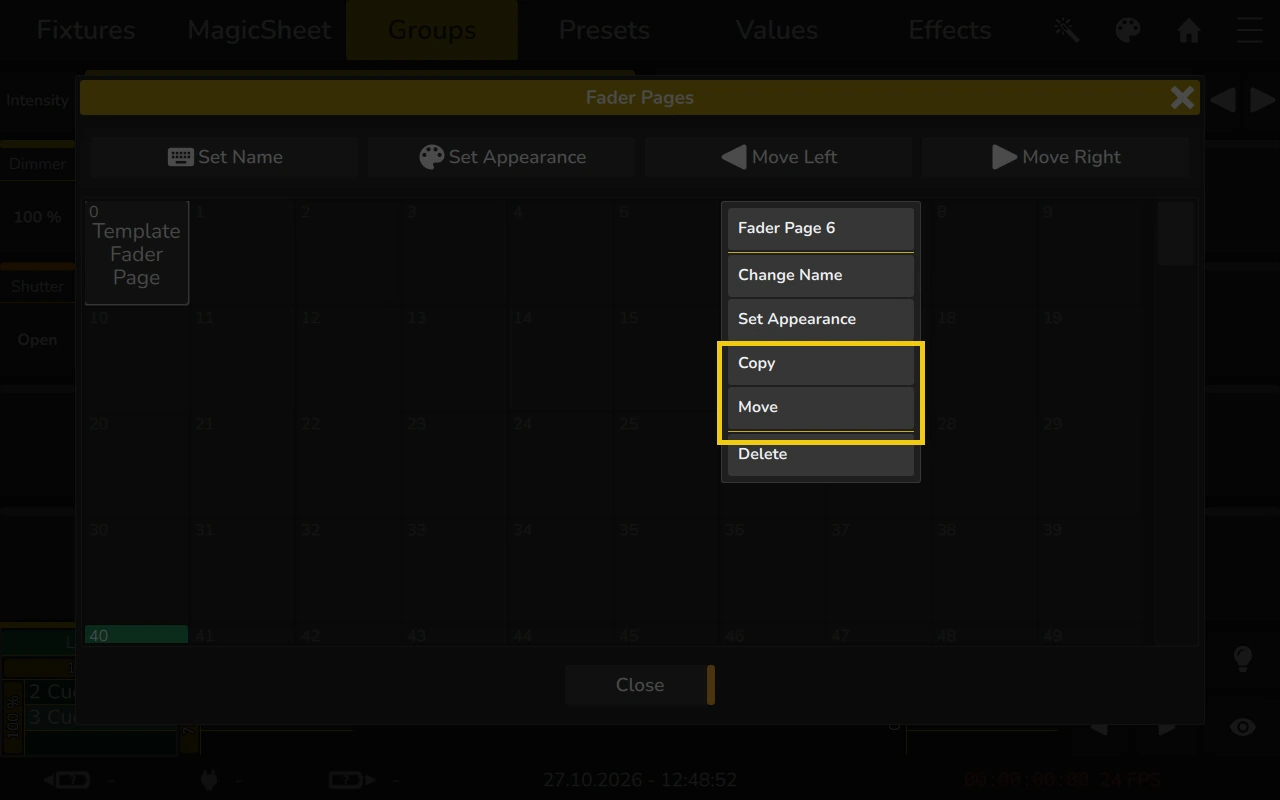
- Long-press the source page and select Copy.
- Tap the destination page.
- Confirm the operation if prompted.
Alternatively, use the Command Line, e.g. Copy FaderPage 1 FaderPage 11.
The complete Playback Page configuration will be duplicated to the selected destination page.
7.6.3 Moving Playback Pages NEW
Playback Pages can be reorganized by moving them to different positions within the Playback Page structure.
To move a Playback Page:
- Open the Fader Page Pool by clicking the Playback Page Button.
- Long-press the source page and select Move.
- Tap the destination position.
- Confirm the operation if prompted.
Alternatively, select a page in the Fader Page Pool and use Move Left / Move Right to move it one position, or use the Command Line, e.g. Move FaderPage 1 FaderPage 11.
This allows greater flexibility when reorganizing Playback layouts and show structures.
7.6.4 Playback Page Appearance NEW
Playback Pages support customizable appearance settings for improved visual organization.
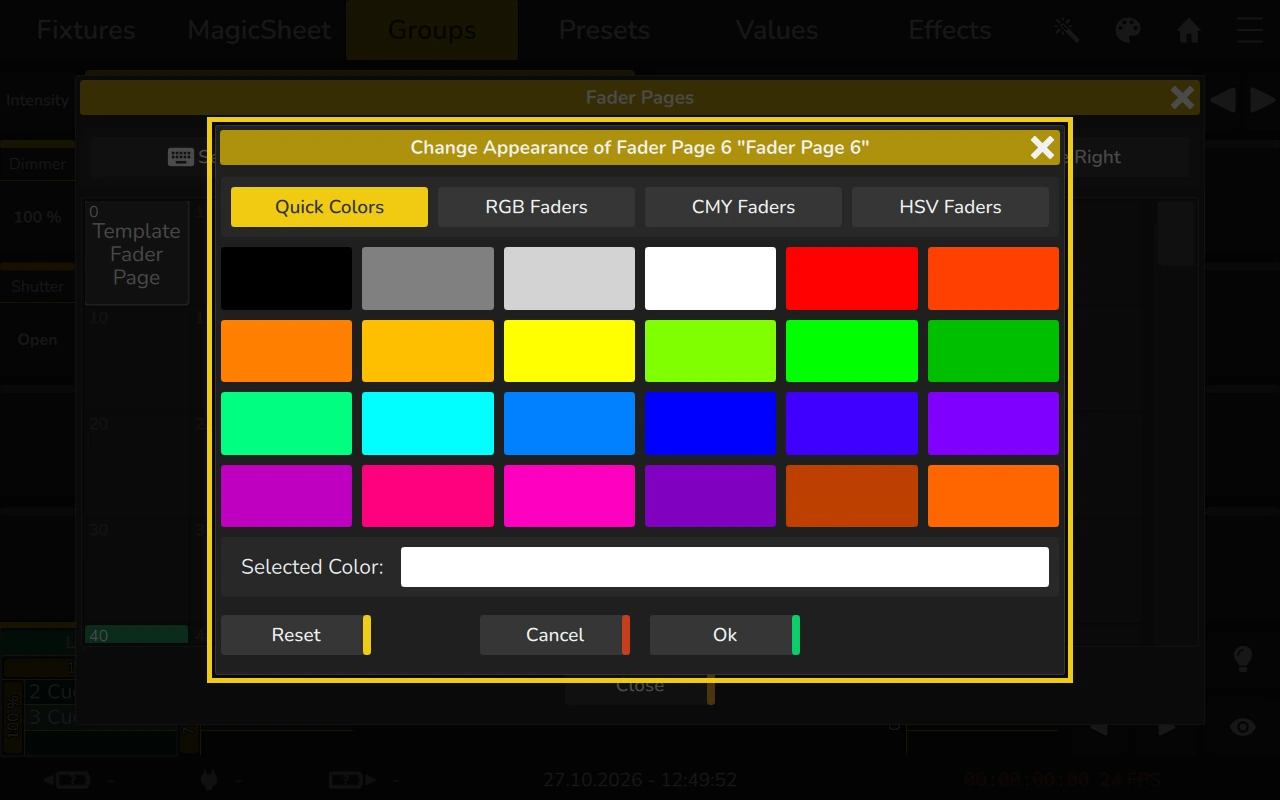
Users can assign colors to Playback Pages, making it easier to visually separate different show sections or operational areas.
The selected page color is displayed directly on the Playback Page button, providing immediate visual identification of the active page.
To set the color, select the page in the Fader Page Pool and click Set Appearance, or long-press the page and select Set Appearance.
7.6.5 Playback Page Scalability NEW
EDGE supports highly scalable Playback Page management, allowing extensive organization of large showfiles.
The Playback Page pool initially displays 250 items and automatically expands as additional pages are created, always showing about 250 free pages after the highest page in use.
The system supports up to 9,999 Playback Pages plus the Template Page, enabling:
- large-scale show structures
- extensive Playback organization
- flexible page management without having to pre-allocate pages
This dynamic expansion system allows Playback structures to grow according to production requirements while maintaining efficient navigation and organization.